Weinhaus cheers Tommy Robinson. Adam John Florek signs the threat. “Please Govern Yourself Accordingly.”
Adam Florek advertises anti-SLAPP litigation. His letterhead carries a seven-page threat naming the journalist who exposed Weinhaus’ operation.

On June 5, 2026, Adam John Florek sent a seven-page litigation threat to one of journalist Jansen Fluegel’s sources. He demanded that the recipient preserve private communications, relevant browsing histories, and every record identifying editorial sources.
The letter’s preservation schedule names seventeen people and organizations. Number three is Jansen Fluegel.
Florek practices privacy law. His website offers anti-SLAPP litigation—the defense of people sued for speaking.
What does a privacy lawyer want with the browsing history of a journalist’s source?
Beside Florek’s signature sits a second: Edward Andrew Weinhaus, identified in the letter as “Chief Legal Counsel” at Florek’s firm. Three days earlier, Fluegel had reported on Weinhaus’ attack sites.
Florek’s co-signer cheers Tommy Robinson—the white supremacist, anti-Black and anti-Muslim agitator who smeared a refugee schoolboy and tracked a journalist to her front door.
Robinson used a private investigator to locate journalist Lizzie Dearden’s home, then turned up there and shouted abuse. In October 2023, a court upheld a five-year stalking protection order against him. Judge Gregory Perrins called the visit “a calculated attempt to bully, intimidate and frighten” her—to retaliate for her reporting, or to stop it.
Robinson went to a journalist’s home. Weinhaus, who cheers him, co-signed a litigation threat sent to a journalist’s source. The privacy lawyer supplied the letterhead.
Seven pages on Adam Florek’s letterhead
The calendar · June 2 – June 10, 2026
On , Fluegel published “It Was Available,” confronting Weinhaus’ public persona with the disciplinary and criminal charges pending against him. Two days later, on , Weinhaus emailed Illinois’ attorney-disciplinary agency, the ARDC, and threatened further attack posts.
The following day, , Florek signed the letter. Five days later, on , a Maryland court issued a warrant for Weinhaus’ arrest.
Weinhaus, the person behind the attack posts, signs beside Florek as lawyer for the operation that produces them. Paint the arrangement on a door and it would read Weinhaus, Florek & Weinhaus.
Florek’s online biography lists clerkships with two federal judges, work at Blank Rome, and a practice built on biometric-information privacy. His own website advertises “Anti-SLAPP litigation” and help for people harmed by the “callous acts of others.” For Weinhaus, he offers the reverse: protection from people who speak.
Fluegel’s Medium post exposed the record behind Weinhaus’ First Amendment pose. Florek answered on his firm’s letterhead, threatening claims for “trade libel,” “defamation,” and interference with business relationships. He identifies not one sentence in Fluegel’s article. He names not one falsehood. He saves his precision for the preservation schedule.
“Please treat this matter,” Florek instructs, “as if a lawsuit has already been filed and litigation is ongoing.” On page two, he itemizes the consequences of any lapse: monetary sanctions, contempt of court, adverse judgment or dismissal. Failure to implement and maintain the hold, he warns, “will be treated as willful spoliation”—deliberate destruction of evidence. Florek is staging a courtroom on his stationery.
Florek calls the recipient a “potential litigant” and threatens claims against people in direct communication with that person. He demands preservation of articles, drafts, notes, emails, texts, and voicemails; of messages on nine named platforms; of every record identifying sources, tipsters, informants, or contributors; and of relevant browsing histories, searches, and downloads.
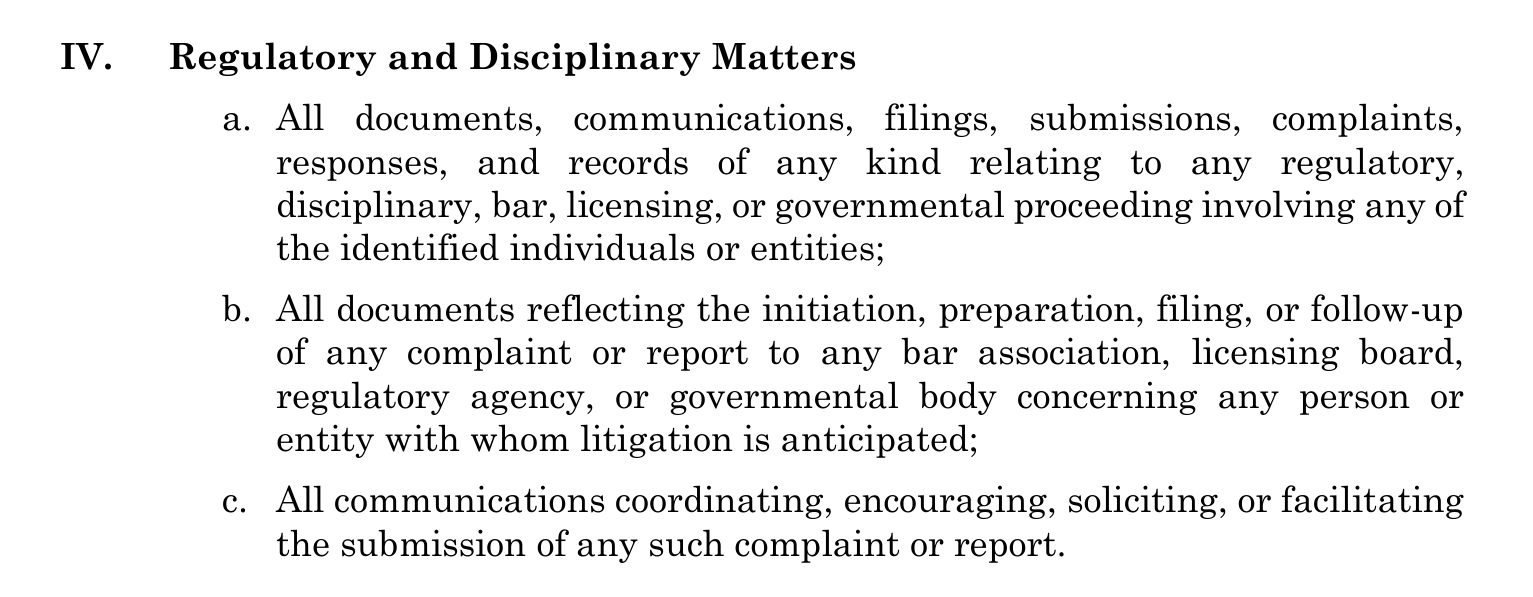
Entries 10–13 on the schedule are attorney regulators: the State Bar of California, California’s Office of the Chief Trial Counsel, the Illinois ARDC, and Missouri’s Office of Chief Disciplinary Counsel. Florek and Weinhaus extend the hold to communications, complaints, filings, and correspondence involving any of the four. Category IV, “Regulatory and Disciplinary Matters,” reaches further, into the preparation of complaints and any communication “coordinating, encouraging, soliciting, or facilitating” their submission.
In July 2019, the Seventh Circuit sanctioned Weinhaus for a custody-related federal appeal it called “frivolous.” The disposition: “AFFIRMED AS MODIFIED, WITH SANCTIONS.” Its September 23 order recorded that he had paid a separate $23,500 state-court attorney-fee award and directed its clerk to send both orders to the State Bar of California—entry 10 on Florek’s schedule.
On page one, the anti-SLAPP lawyer casts Weinhaus’ attack sites as watchdogs of attorney misconduct. On page six, he demands preservation of the communications used to prepare and coordinate misconduct complaints.
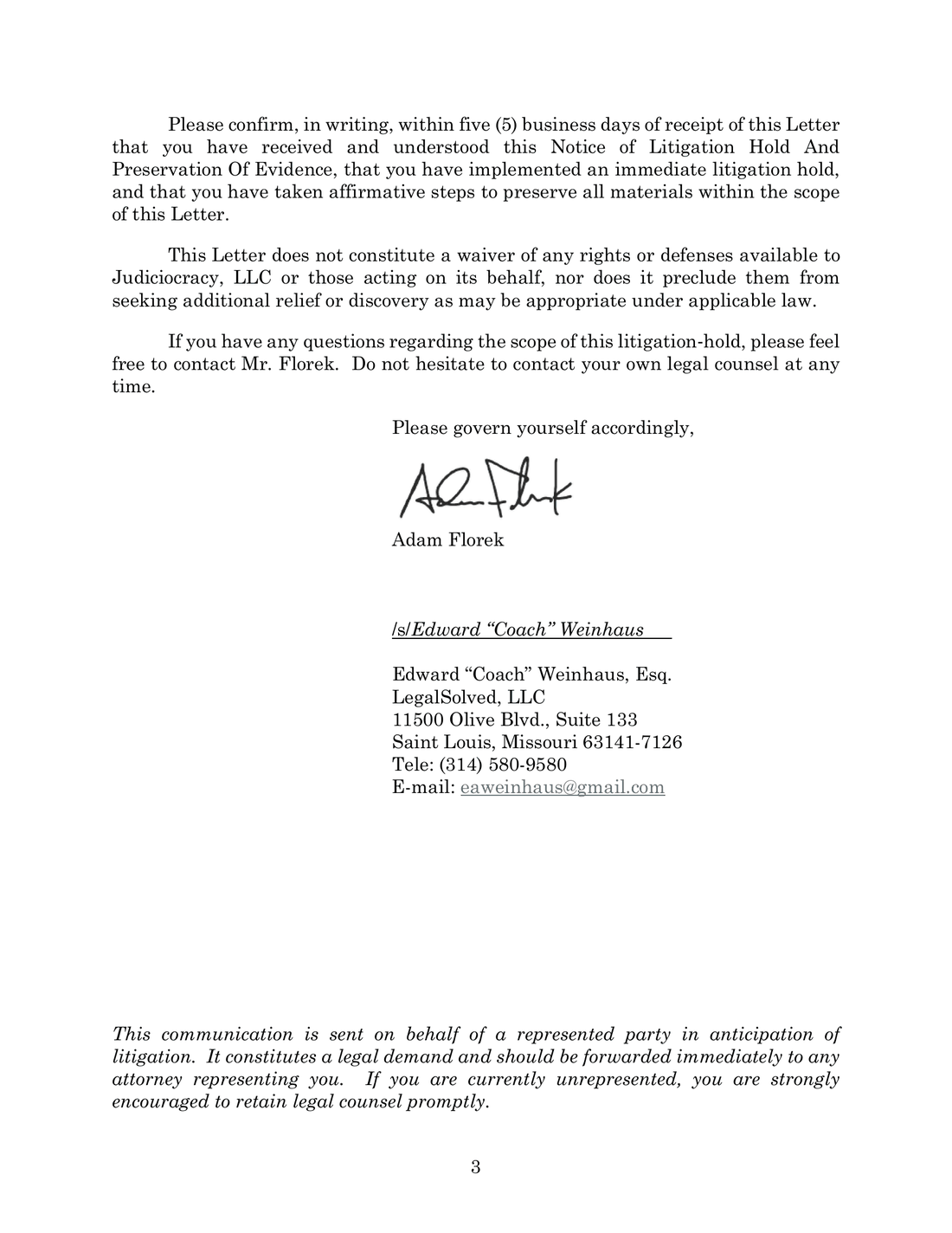
Florek wants written confirmation, within five business days, that the letter has been received, understood, and implemented. Seven pages, seventeen names, six categories of records, five days.
Complete redacted text
Recipient details and twelve schedule entries are redacted. Entries 10–13, identifying California, Illinois, and Missouri attorney regulators and the requested records, are reproduced in full.
Page 1
June 5, 2026

Via US Mail and E-Mail

Re:
Notice of Litigation Hold And Preservation Of Evidence
Judiciocracy, LLC and its agents
My name is Adam Florek and, along with my firm and its Chief Legal Counsel,
Edward “Coach” Weinhaus, we represent Judiciocracy, LLC and its affected agents.
Judiciocracy LLC is a Missouri-based limited liability company in the legal news
space, monitoring the legal system in various areas such as Attorney Misconduct,
Judicial Misconduct, Bar Passage, and more.  We are writing on their behalf.  Please
let this Notice of Litigation Hold and Preservation of Evidence Letter (“Letter”) serve
as a formal litigation-hold notice to you and to all affiliated individuals, officers,
directors, employees, agents, and third parties acting on your behalf.  Please treat
this matter as if a lawsuit has already been filed and litigation is ongoing.
This letter is in anticipation of legal action by Judiciocracy and potentially,
several of its staffers, against certain individuals with whom you are in direct
communication with for, inter alia, trade libel, defamation, and tortious interference
with prospective business relationships.  You are also a potential litigant and should
treat this as notice of same.  The claims arise from but are not limited to false and
disparaging statements about my clients, their publications, their actions in creating
those publications, and their relationship with their customers and audience as well
as your communications, actions, support of and involvement with procuring
statements intended to damage their professional relationships or economic interests.
Accordingly, you are legally obligated to, effective immediately, preserve,
protect, and refrain from destroying, altering, concealing, transferring, or otherwise
disposing of any and all documents, electronically stored information ("ESI"),
materials, records, communications, and tangible things — in whatever form they
exist — that are described in this Letter, the attached Schedule of Materials, and/or
are reasonably likely to bear on the claims and defenses at issue.  This obligation
applies retroactively to all materials currently in your possession, custody, or control,
and continues until further written notice.
Page 2
2
Failure to comply with this litigation hold shall result in severe legal
consequences, including spoliation sanctions, adverse inference instructions,
monetary sanctions, and other remedies available under applicable state and federal
rules.
Your preservation obligation extends to all materials currently in your
possession, custody, or control, including materials held by agents, employees,
contractors, attorneys, except those protected by applicable privilege, which must be
identified in a privilege log, or any other third party acting on your behalf.
You must immediately:

a. Suspend all routine document destruction policies and any automated
deletion or overwriting processes, including email auto-deletion, cloud
storage deletion schedules, and any similar automated processes;
b. Issue a litigation hold notice to any individual or entity under your
direction or control who may possess documents within the scope of this
Notice;
c. Take affirmative steps to identify and collect all relevant documents and
ESI from all applicable sources, systems, and devices;
d. Preserve all backup tapes, archived records, and legacy data that may
contain information within the scope of this Notice; and
e. Document your preservation efforts in writing, as you may be required
to demonstrate the adequacy of your compliance at a later date.
In the event that you fail to comply, courts have broad authority to impose
sanctions for the failure to preserve evidence once a litigation hold obligation has
attached.  Sanctions for spoliation, the destruction, loss, alteration, or failure to
preserve relevant evidence, include but are not limited to:
a. Adverse inference instructions directing the finder of fact to presume
that destroyed evidence would have been unfavorable to the spoliating
party;
b. Monetary sanctions, including the award of fees and costs;
c.
Issue preclusion or striking of claims or defenses;
d. Contempt of court, and/or
e.
Adverse judgment and/or dismissal.
The litigation hold obligation arises when, as here, litigation is reasonably
anticipated, which occurred no later than the date of this letter.  Your failure to
immediately implement and maintain this hold will be treated as willful spoliation
and will be brought to the attention of the court accordingly.
Page 3
3
Please confirm, in writing, within five (5) business days of receipt of this Letter
that you have received and understood this Notice of Litigation Hold And
Preservation Of Evidence, that you have implemented an immediate litigation hold,
and that you have taken affirmative steps to preserve all materials within the scope
of this Letter.
This Letter does not constitute a waiver of any rights or defenses available to
Judiciocracy, LLC or those acting on its behalf, nor does it preclude them from
seeking additional relief or discovery as may be appropriate under applicable law.
If you have any questions regarding the scope of this litigation-hold, please feel
free to contact Mr. Florek.  Do not hesitate to contact your own legal counsel at any
time.
Please govern yourself accordingly,


Adam Florek


/s/Edward “Coach” Weinhaus


Edward “Coach” Weinhaus, Esq.
LegalSolved, LLC
11500 Olive Blvd., Suite 133
Saint Louis, Missouri 63141-7126
Tele: (314) 580-9580
E-mail: [email protected]


This communication is sent on behalf of a represented party in anticipation of
litigation.  It constitutes a legal demand and should be forwarded immediately to any
attorney representing you.  If you are currently unrepresented, you are strongly
encouraged to retain legal counsel promptly.
Page 4
Schedule of Materials

Materials subject to the Notice of Litigation Hold And Preservation Of
Evidence Letter include but are not limited to: any and all documents,
communications, records, data, and electronically stored information relating to,
referencing, originating from, or exchanged with any of the following individuals and
entities:
1. [REDACTED]
2. [REDACTED]
3.
Jansen Fluegel;
4. [REDACTED]
5. [REDACTED]
6. [REDACTED]
7. [REDACTED]
8. [REDACTED]
9. [REDACTED]
10.
The State Bar of California, including any communications sent to or
received from that body, any filings, complaints, submissions, or responses,
and any documents referencing proceedings before that body;
11.
The California Office of the Chief Trial Counsel, including any
communications, complaints, submissions, filings, or correspondence of any
kind;
12.
The Illinois Attorney Registration and Disciplinary Commission ("ARDC"),
including any communications sent to or received from that body, any
filings, complaints, submissions, referrals, or responses, and any
documents referencing proceedings before that body;
Page 5
ii
13.
The Missouri Office of Chief Disciplinary Counsel, including any
communications, complaints, submissions, filings, or correspondence of any
kind;
14. [REDACTED]
15. [REDACTED]
16. [REDACTED]
17. [REDACTED]
Categories Of Preserved Materials include, but are not limited to the
following specific categories of documents and ESI, which must be preserved in their
entirety:
I.
Statements, Publications, and Content
a. All written, recorded, or published statements — whether in articles,
blog posts, social media posts, videos, podcasts, newsletters, emails, or
any other format — concerning or referencing any person or entity with
whom litigation is anticipated;
b. All
drafts,
outlines,
notes,
source
materials,
and
editorial
communications related to any published or unpublished content
concerning any such person or entity;
c. All records identifying sources, tipsters, informants, or contributors to
any such content;
d. All records of publication, distribution, sharing, or amplification of any
such content, including analytics, audience data, and engagement
metrics;
e. All records of corrections, retractions, takedowns, or modifications to
any such content, and all communications related thereto.
II.
Business and Financial Records
a. All contracts, agreements, letters of engagement, invoices, payment
records, and financial transactions with or between any of the
individuals or entities identified in this Schedule of Materials;
Page 6
iii
b. All records of revenue generated from, or expenses incurred in
connection with, any of the identified publications or entities;
c. All records reflecting referral arrangements, revenue sharing,
advertising arrangements, affiliate relationships, or other financial
arrangements involving any identified person or entity;
III.
Communications
a. All emails, text messages, direct messages, instant messages,
voicemails, and other electronic or written communications —
regardless of platform — sent to, received from, or referencing any of the
individuals or entities identified in this Schedule of Materials;
b. All communications on any social media platforms, including but not
limited to Facebook, X (formerly Twitter), LinkedIn, Instagram,
YouTube, Telegram, Signal, WhatsApp, Discord, or any other messaging
or social platform;
c. All communications made through any business collaboration tools,
including but not limited to Slack, Microsoft Teams, Google Workspace,
or similar platforms;
d. All calendar entries, meeting records, and scheduling communications
related to or involving any identified individual or entity.
IV.
Regulatory and Disciplinary Matters
a. All documents, communications, filings, submissions, complaints,
responses, and records of any kind relating to any regulatory,
disciplinary, bar, licensing, or governmental proceeding involving any of
the identified individuals or entities;
b. All documents reflecting the initiation, preparation, filing, or follow-up
of any complaint or report to any bar association, licensing board,
regulatory agency, or governmental body concerning any person or
entity with whom litigation is anticipated;
c. All communications coordinating, encouraging, soliciting, or facilitating
the submission of any such complaint or report.
V.
Business Relationships and Third-Party Contacts
a. All documents and communications relating to any person's or entity's
business relationships, professional reputation, client relationships,
referral sources, contractual arrangements, or business opportunities
with or involving any of the identified individuals or entities;
b. All documents and communications reflecting any effort to contact,
communicate with, or make representations to any third party
regarding the professional qualifications, character, reputation, fitness,
or conduct of any person with whom litigation is anticipated;
Page 7
iv
c. All documents and communications reflecting any effort to discourage,
interfere with, or disrupt any existing or prospective business,
contractual, or professional relationship involving any person with
whom litigation is anticipated;
d. All records of outreach, communication, or coordination among any
combination of the identified individuals or entities.
VI.
Electronically Stored Information
a. All ESI on all devices, systems, and platforms under your possession,
custody, or control, including but not limited to desktop computers,
laptops, tablets, mobile phones, external hard drives, USB drives, and
any cloud-based storage platforms (e.g., Google Drive, Dropbox, iCloud,
OneDrive);
b. All archived, backed-up, cached, or otherwise stored versions of any of
the above-described documents and communications;
c. All
metadata
associated
with
any
relevant
documents
or
communications, which must be preserved in native format and must
not be stripped, altered, or overwritten
d. All web browsing history, search records, and download records related
to any of the identified individuals, entities, or subject matters;
e. All domain registration records, hosting account records, web server
logs, and content management system records related to any of the
identified publications or websites.
He signs off with a courtesy: “Please govern yourself accordingly.”
Peddling snuff pieces on law grads—with Florek’s help

The watchdogs at work: a graduate’s bar-admission rejection, paired with a cartoon of a beaming graduate in cap and gown, diploma folder in hand. Weinhaus turns commencement into the punch line.
He sent a graduate a link through LinkedIn: “I just read our news piece about you.” Then came the sympathy act: “Believe me, I feel u bro.” Signed, Coach.
Weinhaus threatened more. In his June 4 email to the Illinois Attorney Registration and Disciplinary Commission, he describes his sites as “likely tracking” a law school graduate’s behavior and adds: “there do seem to be a lot of juicy stories available.” June 4 email, p. 2.
He sent printed copies of that correspondence to the graduate’s home. The threat came in hard copy.
Weinhaus’ Sick Obsession with Students and Graduates
Weinhaus to the Illinois ARDC · June 4, 2026
The martyr pose, itemized
In the same email, Weinhaus calls the complainants “wanna-be-lawyers,” invokes the First Amendment, and announces: “I think I could do three years in Maryland state prison in my sleep.” He even advertises the “excellent pro bono services” he would provide to other inmates. June 4 email, p. 1.
The prison boast
Weinhaus to the Illinois ARDC · June 4, 2026
The man Weinhaus cheers has already run the experiment. The 2021 libel judgment included an injunction forbidding Robinson to repeat the allegations about the schoolboy. He repeated them in a film he called Silenced. On October 28, 2024, he admitted ten breaches of that order—breaches the judge called “considered, planned, deliberate, direct and flagrant”—and received eighteen months in prison, less three days already spent in custody.
The March 2025 judgment on Robinson’s confinement records what the martyrdom looked like from inside. On arrival at Belmarsh, he told staff that “his conflict is with followers of Islam.” At Woodhill: three hours out of his cell each day for the yard, gym and shower alone; inside, a television, a laptop preloaded with programmes, books, and CD and DVD players. By March, more than 1,250 social calls and eighty social visits, excluding family visits. The man whose film was called Silenced kept calling. The court refused to let his challenge to those conditions proceed.
On April 16, 2025, the Court of Appeal dismissed his appeal against the eighteen-month sentence. The judges found no basis to reduce the term.
On May 20, 2025, the court cut four months from his sentence after Robinson took steps to remove the offending material and committed to obeying the injunction. He left Woodhill on May 27, having served about seven months. The injunction held. Robinson yielded.
Weinhaus offered three years in Maryland state prison “in my sleep.” Prison is easier by email. He sent the boast on June 4. Florek signed the threat on June 5.
“Coach”
In Florek’s letter, Weinhaus is “Chief Legal Counsel.” To graduates, he signed off as Coach—a mentor’s title, the person at the front of the room. Weinhaus once held that role as a lecturer at UCLA Anderson. The graduates on his sites meet a different Coach: full-name attack headlines, mocking cartoons, threats of “juicy stories” to come.
His own rejection came in February 2023, when UCLA Anderson’s dean declined to appoint him as a continuing lecturer, ending his employment. Weinhaus sued the Regents of the University of California, alleging breach of contract and discrimination. A graduate’s rejection got a cartoon. His went to federal court.
The next school was a high school.
Six dollars at the gate
In October 2025, Weinhaus paid six dollars to attend Highland Park High School’s homecoming game. A female student reported him to school staff and security. Repeatedly. The account that follows is not hers. It is his—drawn from his own complaint, as a federal judge later recounted it. Weinhaus v. Bd. of Educ. of Twp. High Sch. Dist. 113, No. 25 C 14662, slip op. at 2 (N.D. Ill. June 25, 2026).
In the second quarter, the student called him “creepy” and reported him to the dean of students. The dean asked him to leave. He refused. Ordered out of the stands, he complied. The student kept complaining to security.
In the third quarter, the dean came back with the head of security and three Highland Park police officers. The student was uncomfortable, the dean told him, because he was “following her.” Id. Leave, or be arrested for trespassing. The dean escorted him out.
Weinhaus sued—the school district, the city, the dean, the head of security, the police chief, and others. Children of the Court and Judiciocracy LLC, both run by Weinhaus, sued with him. The claims: retaliation for his free speech, denial of due process. The lawyer for all three plaintiffs was Adam Florek.
On June 25, 2026, Judge Alonso dismissed the case with prejudice and called the asserted injury “truly minimal.” Id. at 5. The plaintiffs had already tried twice to state a claim. There would be no third. Florek appealed on July 27. On the Seventh Circuit’s docket, the first appellant is listed as Edward A. Weinhaus, “Coach.”
The student at the game had a different word for him.
Pink slime, with a lawyer attached
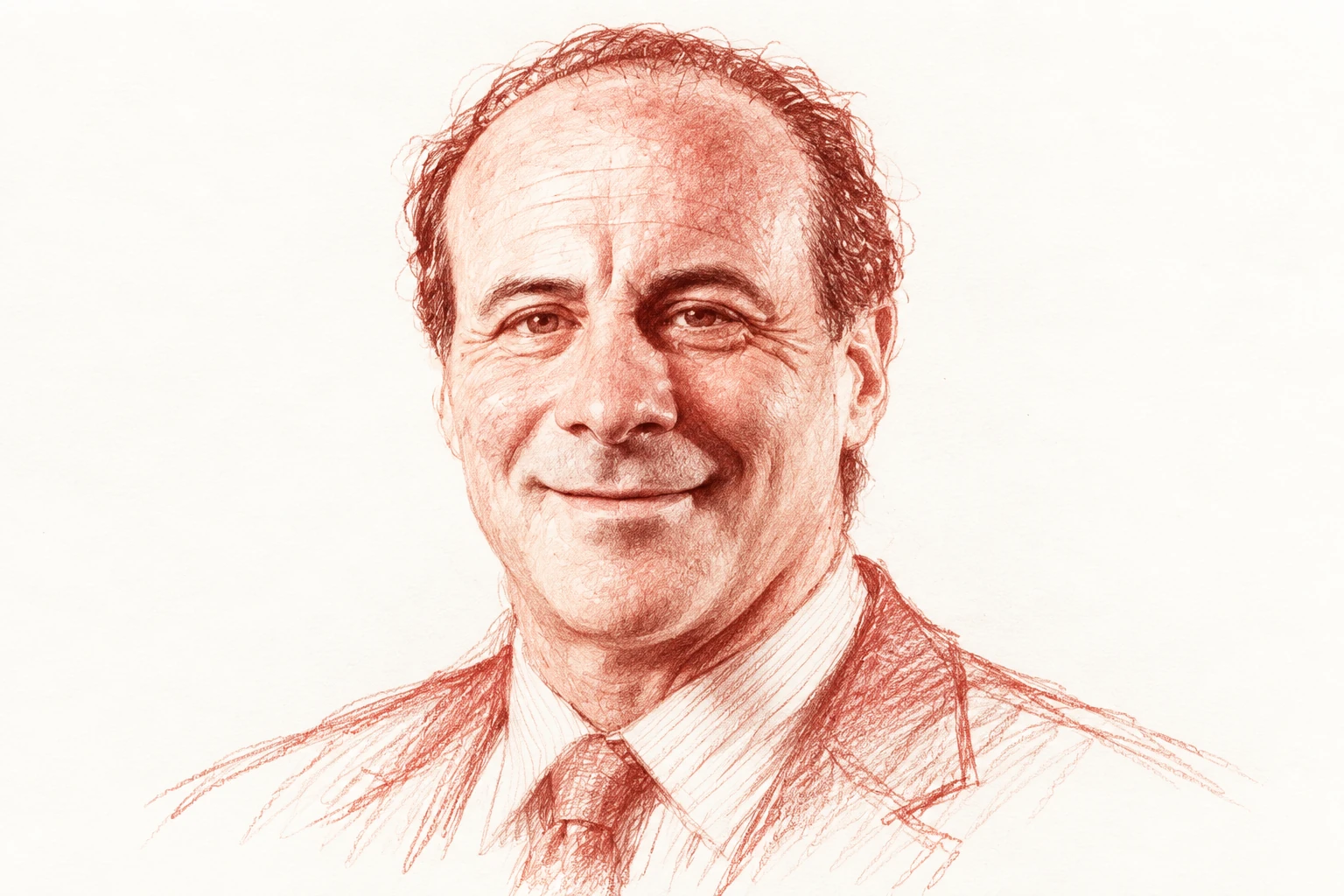
Brian Timpone’s pink-slime network packages partisan campaigns as local news. In a February 2026 investigation, Columbia Journalism Review identified Weinhaus as a lawyer for the network and a co-founder of two of its predecessors. The magazine counted more than nine thousand public-records requests in a single year, followed by attacks on politicians and the publication of identifying details about private citizens who had spoken at school-board hearings.
Weinhaus told the magazine: “I do not care what you’re using the information for. If it’s public, it’s yours and it’s all of ours. Let’s go get it.”
Fluegel went and got it. Florek followed with seven pages of bluster.
Florek and Weinhaus also operate as FOIASolved, litigating public-records cases for a group called the Coalition Opposing Governmental Secrecy. On July 9, 2026, the group obtained an order unsealing Chicago alderman Byron Sigcho-López’s divorce file. His ex-wife’s allegations about escorts and pornography became fodder for attack posts. Florek, the privacy lawyer, sold the exposure as a public service. The voting public, he told the Jewish News Syndicate, “has a right to evaluate all aspects.”
Then the alderman blamed AIPAC, the pro-Israel lobbying group, for the release—and Florek, Weinhaus and the coalition sued him and members of his campaign over statements linking Weinhaus to AIPAC.
The news tracker MassFOIA catalogs their lawsuits beside stories from Timpone’s sites. Its slogan is “Transparency pays.” They pry open an alderman’s divorce file. They threaten a journalist and his source for exposing Weinhaus. The watchdogs have found something worth guarding.
Free speech, until it points at them
Florek on public scrutiny
“These kind of personal shortcomings certainly speak to a person’s character”
Speaking about Sigcho-López’s unsealed divorce records.
The Center Square · August 19, 2026The letter he signed
“All records identifying sources, tipsters, informants, or contributors to any such content”
Listed for preservation in Florek’s June 5 letter to Fluegel’s source.
Preservation schedule · Category I(c) ↓The judge on the “Team” page
Children of the Court, one of the two entities that sued beside Weinhaus over the football game, was founded in 2023 by Weinhaus and students in a class he taught at UCLA. A settlement in an unrelated case, approved by Judge Thaddeus L. Wilson, provided funding for the group. Wilson’s photograph then appeared on the group’s “Team” page as its “Nationwide Enforcer.” A post on one of Weinhaus’ attack sites went further, claiming Wilson had ordered the group into existence to keep Judge Regina Scannicchio away from cases involving children.
The ARDC, one of the four regulators on Florek’s preservation schedule, charges in an April 2025 disciplinary complaint that Weinhaus knowingly or recklessly misrepresented Wilson’s role: Wilson had not started the group, had not joined its team, and had not assumed responsibility for its operations or funding.
Five days before that complaint was filed, Children of the Court and Judiciocracy sued the ARDC, claiming that its pursuit of Weinhaus violated their First Amendment rights. In December 2025, Judge April M. Perry dismissed the suit. She called their allegation that the ARDC was pursuing Weinhaus to silence them “frankly implausible.” The commission could discipline Weinhaus; it had no authority over the two entities.
The two entities also wanted a declaration that statements on their sites were their own speech, separate from Weinhaus’. Perry answered: “the Rules of Professional Conduct prohibit attorneys not only from making false statements, but also from making misstatements through others.” Florek is handling the appeal.
On September 18, 2026, Weinhaus and his entities filed another federal suit, naming the commission’s administrator, Lea Gutierrez, and Cook County Judge Jill Rose Quinn as defendants.
“Frankly implausible” in the ARDC suit. “Truly minimal” in the football case. Florek appealed both dismissals—to the court that once called a Weinhaus appeal “frivolous.”
Weinhaus Faces Stalking Charges
Florek threatened a journalist’s source with contempt of court on June 5, 2026. Five days later, on June 10, a Maryland court issued an arrest warrant for Weinhaus. The court found probable cause for two harassment counts concerning conduct on June 9—four days after Florek’s letter. Maryland Criminal Case Docket, No. D-06-CR-26-005694, pp. 1–2.
Stalking charges have also been filed against Weinhaus in a separate Maryland case. A court put Robinson, the man he cheers, under a five-year stalking protection order. Weinhaus chose his hero well.
Keep the signature
Florek demanded that the record be kept. Keep this one.
Keep the cheer for Tommy Robinson. Keep the cartoon cap and gown, and the printed copies sent to a graduate’s home. Keep “in my sleep.” Keep “Coach” on the Seventh Circuit’s docket, and the word a student used instead. Keep “Let’s go get it.” Keep the voting public’s right “to evaluate all aspects.” Keep the seven pages, signed three days after a journalist exposed the operation and five days before a court issued a warrant for the co-signer’s arrest. Keep Jansen Fluegel’s name at number three.
And keep Adam John Florek’s signature. It puts two federal clerkships, a privacy practice, and a bar card behind Weinhaus’ predatory operation.
Received and understood.